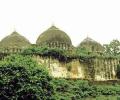
'Pass the law on Ram temple without any delay and stop fooling the majority'

Adityanath spent hours reviewing the arrangements for the ceremony at the Ram Janmabhoomi, where the temple will be constructed following the go-ahead last year by the Supreme Court.
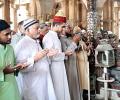
"It is the greatness of Ayodhya that the mosques surrounding the Ram temple are giving a strong message of communal harmony to the rest of the world," Haji Asad Ahmad, the corporator of the Ram Kot ward, told PTI.
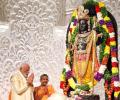
BJP sources suggest that the upcoming elections will likely revolve around the renewed enthusiasm for the temple unless another theme with religious and nationalist undertones emerges.

The foundation for the temple has now been filled with the final, 48th layer of roller-compacted concrete, temple trust members told reporters on Thursday.
In a historic verdict in November on the Ramjanmabhoomi-Babri Masjid dispute, the Supreme Court ruled in favour of construction of a temple. It also ruled that an alternative five-acre plot must be found for a mosque within Ayodhya.
The state government has allotted the five-acre plot in Ayodhya's Dhannipur for the construction of the mosque on the directive of the apex court.

"The design of the mosque has been prepared using modern technology, and it will be egg-shaped without any dome. The two-storeyed mosque will not have any minaret. Solar power will be installed in the mosque, and around 2,000 people will be able to offer 'namaaz' at the same time," he said.
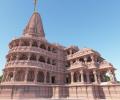
The ground floor of the three-storey Ram temple in Ayodhya is in its final stages and the work on ancillary structures is going on in full swing for their completion by October this year, the temple authorities said on Monday.

The plea, filed by advocates Shishir Chaturvedi and Karunesh Kumar Shukla, said that apart from private individuals and members of state Sunni Board, the presence of central and state government representatives was essential to ensure proper management of the funds.
A court in Varanasi on Friday directed the Archaeological Survey of India to conduct a "detailed scientific survey" -- including excavations, wherever necessary -- to determine if the Gyanvapi mosque located next to the Kashi Vishwanath temple is built upon a temple.
AIMPLB member Zafaryab Jilani on Wednesday said the proposed mosque in Ayodhya following last year's Supreme Court verdict is against the Waqf Act and 'illegal' under the Shariat laws.
During the freedom struggle, Shah had launched revolts in the Awadh region. He made the local mosque, Masjid Sarai, located in Chowk area of Faizabad his headquarters. As he liberated Faizabad and larger part of Awadh region, he used the premises of this mosque to hold meetings with rebel leaders.
The Supreme Court on Friday allowed Bharatiya Janata Party leader Subramanian Swamy to intervene in the pending matters relating to the Ayodhya title dispute with his plea seeking construction of Ram temple at the site of demolished disputed structure.

"Interim orders wherever granted shall continue. Re-list in first half of April, 2024," the bench said in its order and directed the parties to complete the pleadings by then.
But three years after the apex court settled the Ram Janmabhoomi-Babri Masjid land dispute, there are no signs of any building activity on the proposed mosque site.

He also said that now everyone should listen to RSS chief Mohan Bhagwat's advice to shun habit of fighting on small disputes.
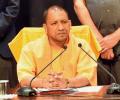
"We are developing Ayodhya in this Kalyug as Ayodhya was in Treta Yug," he said, referring to mythical times.
The Mathura Shahi Masjid Eidgah Committee has approached the Supreme Court, requesting the court to prevent the central government from filing a response to a petition challenging the Places of Worship Act's constitutional validity. The committee accuses the BJP-led government of intentionally delaying its response. The court had previously issued a notice to the government in March 2021, but the government has yet to submit its reply despite numerous opportunities. The committee argues that the government's delay is intended to obstruct those opposing the challenge to the Places of Worship Act from filing their own responses. The petition also states that the pleas challenging the law's validity are scheduled for hearing on February 17, and closing the government's right to respond would serve justice. The Supreme Court previously issued a ruling in December 2022 that stopped courts from entertaining new lawsuits or issuing interim or final orders regarding the reclaiming of religious places, particularly mosques and dargahs. The ruling halted proceedings in 18 lawsuits filed by Hindu groups seeking surveys to confirm the original religious character of 10 mosques, including the Gyanvapi Masjid in Varanasi, the Shahi Idgah Masjid in Mathura, and the Shahi Jama Masjid in Sambhal. This decision was made in response to six petitions, including one filed by lawyer Ashwini Upadhyay, challenging various provisions of the Places of Worship Act. The 1991 law prohibits the conversion of places of worship and guarantees the preservation of their existing religious character as it stood on August 15, 1947. Notably, the dispute regarding the Ram Janmabhoomi-Babri Masjid in Ayodhya was excluded from this law. There are also several cross-petitions advocating for a strict enforcement of the 1991 law to uphold communal harmony and maintain the current status of mosques that Hindu groups seek to reclaim, claiming they were temples before being destroyed by invaders.

The Shia Waqf Board is drafting the terms and conditions of a mutual agreement.
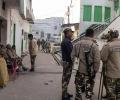
A four-member team from the Archaeological Survey of India (ASI) conducted a survey of the recently-discovered Shri Kartik Mahadev temple, five pilgrimage sites, and 19 wells in Sambhal, Uttar Pradesh, India. The survey followed the discovery of three damaged idols inside a well of the Bhasma Shankar temple, which was reopened after being shut for 46 years. The Shri Kartik Mahadev temple, also known as the Bhasma Shankar temple, was reopened on December 13 after authorities found the covered structure during an anti-encroachment drive. The temple houses an idol of Lord Hanuman and a Shivling and had remained locked since 1978. The district administration has requested carbon dating of the temple, including the well, from the ASI. Meanwhile, the Supreme Court has restrained courts across India from entertaining new lawsuits or passing any orders in pending ones seeking to reclaim religious places, especially mosques and dargahs, until further notice. This action halts proceedings in approximately 18 lawsuits filed by Hindu parties seeking surveys to determine the original religious character of 10 mosques, including the Gyanvapi at Varanasi, the Shahi Idgah Masjid at Mathura, and the Shahi Jama Masjid at Sambhal, where four individuals died in clashes. The Supreme Court will examine the legality, scope, and boundaries of the Places of Worship (Special Provisions) Act, 1991, which prohibits the conversion of places of worship and ensures the preservation of their religious character as it existed on August 15, 1947.
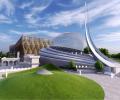
The mosque is coming up in the Uttar Pradesh district pursuant to the Supreme Court verdict in the Ram Janmabhoomi case.
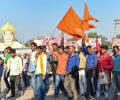
'I am more concerned about my future, my family's future. The fate of the Ram temple is neither going to affect my career, nor would I let it be affected'
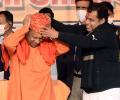
A magnificent Krishna Janambhoomi temple in Mathura was a recurrent theme for the ruling BJP in the run-up to the assembly polls, reports Nitin Kumar.
"The Trust chose January 26, 2021 for laying the foundation stone of the Ayodhya mosque as on this day our Constitution came into effect over seven decades ago. Our Constitution is based on pluralism, which is the leitmotif of our mosque project," said Athar Hussain, secretary of the Indo-Islamic Cultural Foundation (IICF).
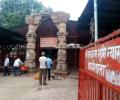
The Shri Ram Janmabhoomi Teertha Kshetra Trust reported that a five-foot shivalinga, seven black touchstone pillars, six red sandstone pillars, a 'flower pinnacle' and four broken idols of gods and goddesses were found.
The Deepa Thoon controversy, if not allowed to die a natural death, could take the election focus away from the anti-incumbency impacting the DMK and into the secular space. Stalin would love to have it that way, all over again, after the three past elections, points out N Sathiya Moorthy.

Mir Baki was not the commander who had led the invasion on Ayodhya, Mishra said leading the bench to ask him as to what he was trying to prove by referring to these historical books.

Mohan Bhagwat said the temple would be constructed in the same grandeur as it existed before, using the "same stones" under the guidance of those who were the flag-bearers of the Ram Janmabhoomi movement for the last 25 years.

Rizvi along with some Mahantas from Ayodhya will also approach the Supreme Court before December 5 with a solution to the Ram Janmabhoomi-Babri Masjid dispute.

The Vishwa Hindu Parishad on Saturday demanded that a grand Ram temple be built in the 67 acre plot surrounding the disputed site in Ayodhya and said 'no new mosque' can be built there as it has been established as the birth place of Lord Ram.
'The idea is to have a place where people can come together and bridge the gap. It will be a contemporary design for the future, and not have the shadows of the past' Ritwik Sharma reports.

Earlier on Wednesday, the district court ruled that a priest can perform prayers before the idols in a cellar of the Gyanvapi Masjid, a significant development in the legal battle over the mosque adjacent to the Kashi Vishwanath temple.
'Chandra Shekhar used to say that some people may oppose such a decision from their mouth, but all will accept it from their heart as the best solution to the dispute.'
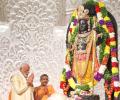
The BJP enters challenging times where it has been given a task to hold onto the values of Ram in running the country as defined by Narendra Modi in Ayodhya, notes Sheela Bhatt.

When the temple issue predominated BJP's discourse, its victory margins have been narrow.

Narendra Modi has proved through execution of this event in Ayodhya that amongst all his contemporaries in politics he knows ordinary Indians like none other, notes Sheela Bhatt.
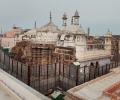
In a major victory for the Hindu side, a Varanasi court on Wednesday allowed Hindu devotees to offer prayers inside the 'Vyas ka Tekhana' area inside the Gyanvapi mosque complex.
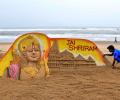
The following is the chronology of events related to the Ram Janmabhoomi-Babri Masjid land dispute in which, after the Supreme Court verdict, Prime Minister Narendra Modi on Wednesday conducted the 'Bhoomi Pujan' or ground breaking ceremony and laid the foundation stone for the temple's construction.

Prayers were performed in a cellar of the Gyanvapi mosque in Varanasi on Wednesday night following court orders allowing the resumption of a practice said to have been discontinued three decades back, Kashi Vishwanath temple trust president said.
